The Product
Gastropod gives you one address to point every package manager at, in place of the registry URLs you use today, and attaches identity, provenance, advisories, an SBOM, and a full audit trail to each artifact. Point your existing clients at it; there is nothing new to learn.
See it in action
Real screens from the registry: the whole supply chain at a glance, a malicious npm package caught at intake, and exactly where it is being used.
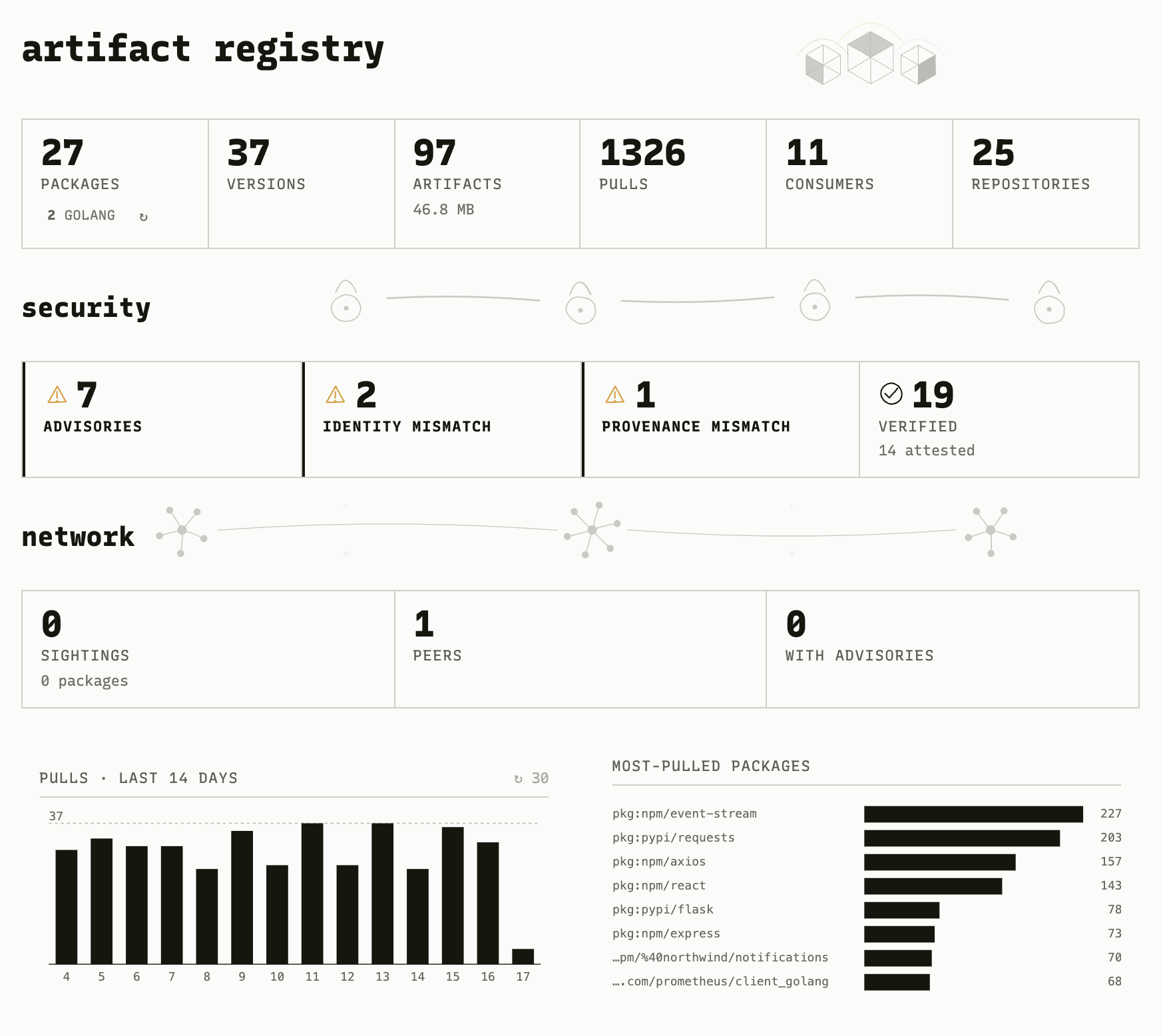
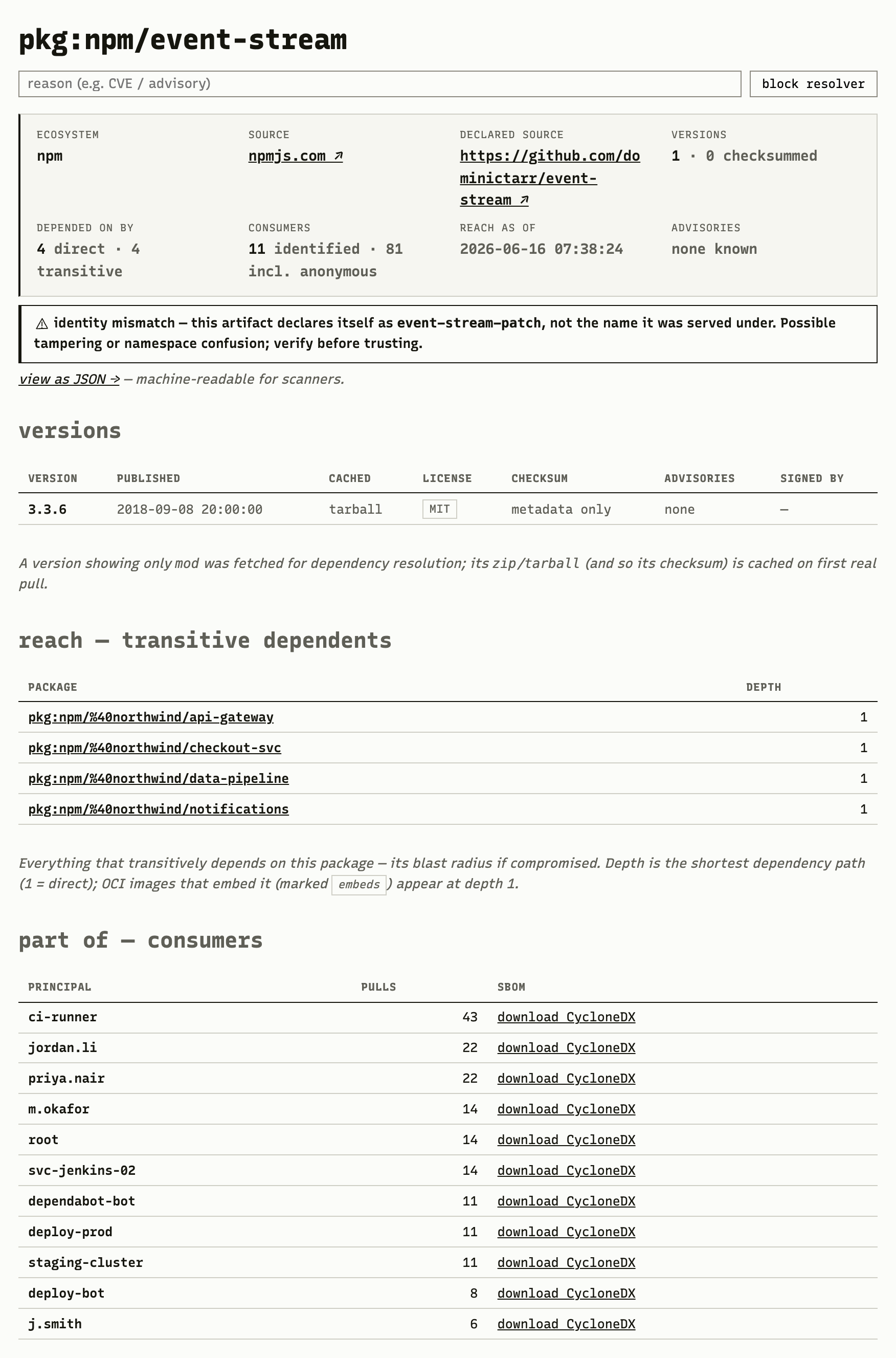
event-stream on an
identity mismatch (it declares a different name than it was served under), showing
the blast radius (the services that pulled it) and every consumer, each with a CycloneDX SBOM.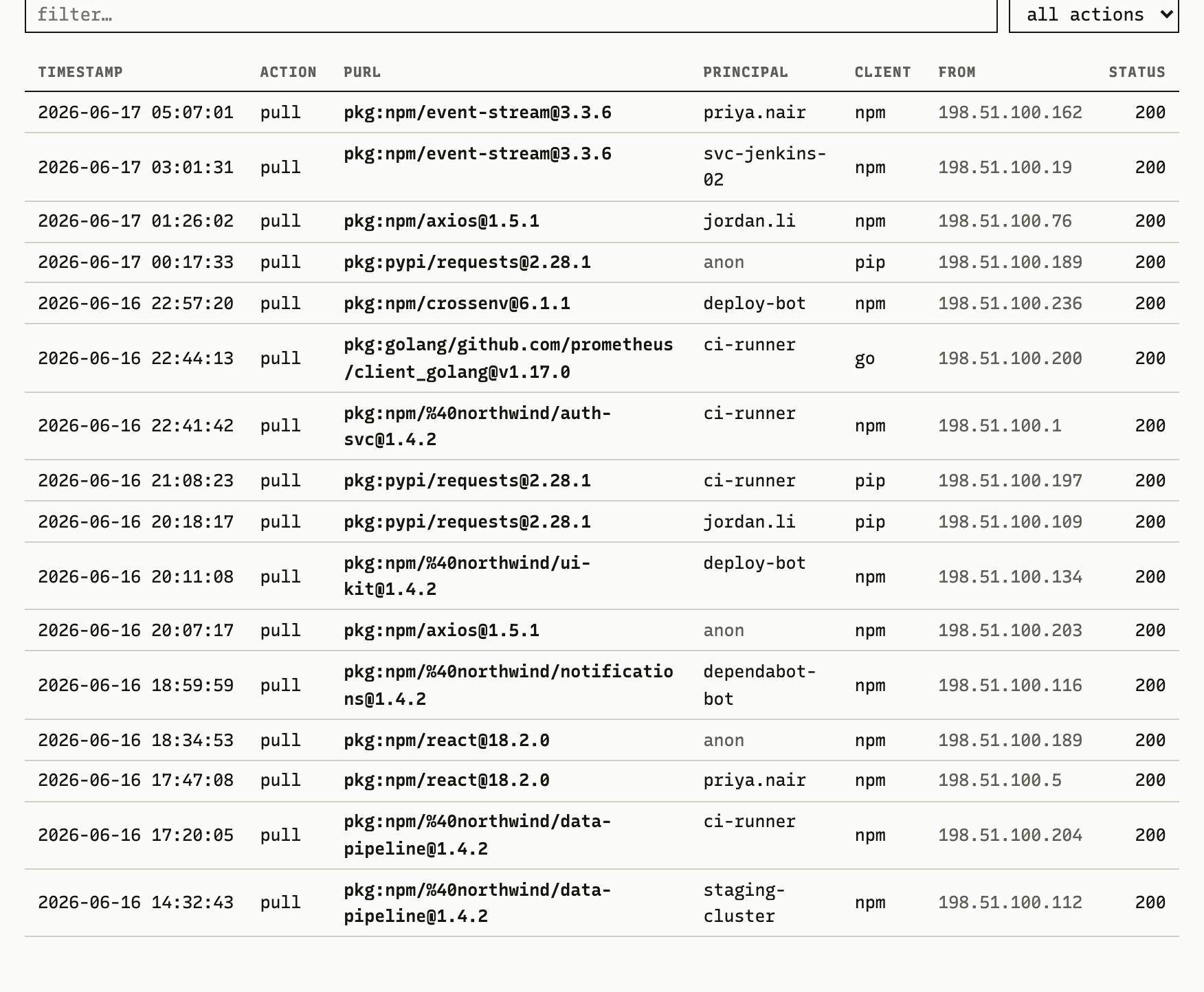
Every ecosystem, one registry
Gastropod hosts or proxies Go modules, npm, Debian/Ubuntu, OCI containers, Python (PyPI), Maven & Gradle, Alpine (apk), RHEL family (rpm), .NET (NuGet), Ruby (RubyGems), and Helm charts, plus on-demand source proxies for GitHub and GitLab. Set one variable, and your toolchain works without further changes.

Go modules
GOPROXY=…/go

npm
registry=…/npm/

Debian / Ubuntu
deb …/deb/<distro>

OCI containers
docker pull …/<repo>

Python (PyPI)
--index-url …/pypi/

Maven & Gradle
repository …/maven/

Alpine (apk)
…/apk/<repo>

RHEL family (rpm)
baseurl=…/rpm/

.NET (NuGet)
nuget source …/nuget/

Ruby (RubyGems)
mirror …/gem

Helm charts
helm pull oci://…/<chart>
…more coming soon.
Connect in one line
Point your existing clients at Gastropod; it requires no new tooling.
Replace TOKEN with the value shown when you issue one; <org>/<repo>
is a hosted repository.
# credentials go inline in GOPROXY
export GOPROXY=https://you:TOKEN@gastropod.io/go
export GOSUMDB=off   # private modules aren't in the public checksum db
How it works
A package flows through Gastropod on its way to a build. Gastropod attaches identity, findings, and provenance that persist everywhere that exact digest appears.
See
An artifact appears via a proxy pull, a push, or a CI job.
Resolve
Gastropod builds an identity: PURL, version, ecosystem, source, and sha256 digest.
Verify
Gastropod verifies each artifact against the authoritative source for its ecosystem, and correlates OSV advisories.
Attribute
Gastropod records who did every pull in the access spine: what they pulled, from where, and when.
Remember
Gastropod attaches advisories, the CycloneDX SBOM, provenance, and dependents to the artifact identity.
Reuse
The next appearance of that exact digest inherits the intelligence, with no rework required anywhere in your organization.
Gastropod vs. a traditional artifact repository
Artifact repositories move bytes reliably; Gastropod does that too, and adds the intelligence and audit layer that other repositories leave to add-ons and higher tiers.
| Capability | Gastropod | Traditional artifact repo |
|---|---|---|
| Multi-ecosystem proxy & hosted registry | built in | built in |
| Content-addressed, deduplicated storage | core design | partial |
| PURL-native artifact identity | first-class | partial |
| Provenance verification (Go h1, npm SRI, Sigstore) | built in | add-on |
| CycloneDX SBOM on demand | built in | add-on |
| OSV advisory correlation at the artifact | built in | separate product |
| Blast-radius / transitive-dependent graph | built in | limited |
| Per-pull attribution audit spine | core design | higher tier |
| Scanner findings ingest (bring your own) | built in | own scanner |
| Self-hostable | yes | yes |
This is a directional comparison of the category. Security and intelligence features are generally separate products or higher tiers in traditional artifact repositories. Verify specifics against each vendor's current documentation.
Comparing against a specific product? See gastropod vs. Artifactory, Nexus, or Cloudsmith.
The full feature list
Every capability is on every tier. Rates, limits, and SLA change between tiers; feature access does not.
registry & ecosystems
- Proxy & hosted repos for Go, npm, Debian/Ubuntu, OCI, PyPI, Maven & Gradle, Alpine apk, RHEL rpm, NuGet, Ruby (RubyGems)
- On-demand source proxies for GitHub & GitLab
- Content-addressed sha256 storage, deduplicated across the instance
- Virtual / aggregate repositories
- Point existing clients at it: no extra tooling required
artifact intelligence
- PURL-keyed identity and where-seen history
- OSV advisory correlation per package version
- CycloneDX SBOM reconstructed on demand
- Direct & transitive blast-radius graph
- Provenance: Go
sum.golang.orgh1, npm SRI, Sigstore, signed apt - Identity- and provenance-mismatch flags
control & audit
- Per-pull access spine: every pull tied to who did it
- Exportable audit log and access events
- Block rules at the point of intake
- Scanner findings ingest (Trivy, Grype, Snyk, Anchore; CycloneDX, OpenVEX, JSON)
access & security
- SSO via OIDC: on every tier
- Role-based access control (admin / publisher / reader)
- Scoped API tokens
- Encrypted in transit and at rest
- Per-tenant isolation
deployment & support
- Fully-managed cloud, or self-hosted
- 99.9% uptime SLA (Business); custom SLA (Enterprise)
- Full audit log and access events